Monday, May 13, 2013
Gatsby? What Gatsby?
Assigned to me to read the summer before my sophomore year, Gatsby initially went right over my head. While it was my favorite summer reading book to me that year, that's all it was: summer reading. It wasn't until I re-read the novel just now that I realized its sheer brilliance.
Reading it before had been a bore, a necessity. I had to force myself to sit down to read only five pages. The way that I lay down just now for four and a half hours and read it cover to cover means either that I just had preconceived notions of the novel because it was summer reading, or that I'm older now and with more life experiences the material didn't fly right over my head. I have a feeling it's a little bit of both.
And when I say that it flew over my head when I initially read it, I mean it flew. It started with the way I didn't know how I was supposed to envision the West and East Eggs. The descriptions of the city didn't draw me in as they did now. The color imagery was so vivid - and Gatsby reaching for that green light. I didn't have any recollection of why that pair of "eyes" was such a big deal to the novel - probably because I had so much trouble then with the concept of the Eggs and the valley of the ashes. The eyes of T.J. Eckleburg thoroughly creeped me out every time they were mentioned because I knew it was supposed to be sort of God or morality frowning upon the characters who in such a short amount of time I was able to grow to love (for what they were).
I have a tendency to cling to the sweet, naive female characters in stories, and Daisy was no exception. I loved her from her first scene. But as I got past the mid-point of the novel, I stopped loving Daisy so much. After finishing I needed to contemplate that. It's not normal for me to lose faith in a character like I did Daisy. I felt like a disappointed parent. But then I realized: that was the entire point. While at first all we see of Daisy is her sweet, quirky demeanor and the outpouring of love from others to her, later she takes a different, crooked path, leaving Gatsby in his time of need. Gatsby was willing to stand below her window until four in the morning to make sure that her husband didn't hurt her and she wouldn't even acknowledge his death. Daisy herself is a personification of how vapid the wealthy could and still can be. I still love her for what she is - a beautiful little fool. And I only grew to like Jordan (who'd been my favorite character upon my first read-through two years ago) even more.
Moving On
The Unauthorized Autobiography of Samantha Brown is a little-known musical by Kait Kerrigan and Brian Lowdermilk. The show is (of course) about a girl named Samantha Brown and her last year in high school. She's her class valedictorian and her life is extremely average - the show picks up with Sam singing "The oldest story in the book, why give it a second look?" But Sam's story is incredibly poignant for the fact that she is average. I find myself on the verge of tears writing this. Sam's entire story is that she has no idea where she's going. She seems like she should have it all set. She has a perfect family, perfect friends, a perfect boyfriend, and she's top of her class. But she can't decide where to go to college. Her parents both force their own alma maters on Sam, who wants nothing more than to branch out and find out who she is on her own.
My friend gave me the music from the show as a present because I love the actress who plays Sam in it (her name is Meghann Fahy). Somewhat coincidentally, she gave it to me towards the beginning of my senior year. I remember blaring one of the songs in my car on the way to Perkins for breakfast on Spirit Day this year at six in the morning. Spoiler alert - Sam's best friend Kelly dies in a car accident. She's dead throughout the entire show as Sam replays her senior year in her mind before she leaves for college. One of my close friends also got in a major car accident just a few days before my friend gave me this show. She was nearly paralyzed and could have died had the accident been any worse. I remember one night listening to Kelly and Sam's final duet where Sam finally comes to terms with Kelly's death. And I just cried and cried. My high school experience has been completely average. Even more average than Sam's. I'm not class valedictorian. I've made no major impact on anything. Sam IS a crappy driver, so I can relate there. Just a plain, dumb, ordinary senior year. And yet, as much as I can say I hated this year, I know that this year I've become all-around a more optimistic person. So there's at least that.
I wouldn't say that Sam Brown has been the soundtrack to my senior year. I listened to it a lot in the beginning, even more after my friend's accident. But then I stopped. Right now I'm listening to it for the first time since probably January. And when I first got the show I recognized what a happy coincidence it was that Sam was going through the exact same things as me as I was living them. But I stopped, and I honestly couldn't tell you why. It's maybe better this way. Rediscovering it a week before the end of my senior year is just kind of sad, but at the same time it's really fitting, especially for the fact that she entire show is Sam looking back. I'm looking back writing this post. And I'll do it again before I go to school next year.
The musical is as of yet unfinished, and it's extremely difficult to find good versions of it online (the videos on Youtube of the production with Meghann Fahy don't do it justice and only have like two of the songs). It's really beautiful and I recommend it if you ever get the chance to see it. Plus, there's an official demo recording out there somewhere.
"These ordinary years make us who we will become... Seniors, let's reach for the sky. Say goodbye to high school, and face the world. Though we don't know what we'll see there, we know that we'll be there together. It's time to kick some ass- for all you lower classmen, sucks for you! Peace out to all of you. The party's gone, we're moving on."
Thursday, May 9, 2013
ALLIE BROSH IS BACK
It was last summer that I came across her blog Hyperbole and a Half. By the time I found it, it had already been ditched for over a year. I found her blog through her cute, Microsoft paint-like drawings being used as memes on Tumblr. I wanted to know why her person had a yellow shark fin on their head (I found it's supposed to be her ponytail). And upon finding and visiting her blog, I was taken by her clever drawings and stories. Her last post however, before she left her blog, was about her crippling depression. Which was a cause of alarm for many, I'm sure. I, of course, went on to think the worst: sure, it was possible she just didn't have the energy to run the blog anymore (the posts are really intricate with all of the drawings). There are plenty of reasons she could've left. I just like to worry, I guess.
Her last newest post (right before the depression one) was about how she was getting a BOOK. PUBLISHED. A flesh and blood, paper and binding book of her drawings and hilarity that I'd pored through and fallen in love with upon discovering her blog. I was so excited. I went to Barnes and Noble.com immediately then to see if I could buy it yet - and there was nothing. Her work seemed like something that might be at Urban Outfitters too, so I went to that website. Nothing. And disappointment. I started to think she might not write the book since she wasn't updating the blog anymore. I checked the blog for updates for quite some time, and it was always the same.
Now I realize that maybe she left the blog for a while because she was busy writing the book (which was supposed to be released Fall 2012). Maybe she left because she really was too depressed (which seems to be the case). Either way, she left because she needed to. And what matters now is that SHE'S BACK! Also that HER BOOK IS ON PRE-ORDER! And I'm totally getting it. And I guess the point of this post is that you should totally check out her blog and maybe get it too.
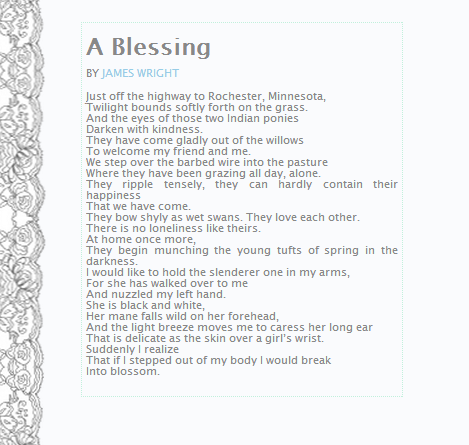
"A Blessing" by James Wright
I really loved this poem when we read it in class. I was actually thrilled (no exaggeration) when it came up again today. Not only because I knew that knowing the poem from beforehand would be a big help, but I'd also forgotten all about it. As much as I hated analyzing poetry, I really loved this poem in particular. Not only does it have wonderful imagery, but it's happy. It's a poem about sweet horses and happy people and just gives off a nice vibe altogether. It's fitting for it to be called "A Blessing". All the rest aside, I think I was drawn to the poem because even though it explicitly says in the first line that is takes place in Minnesota, the first time I read it I somehow missed that and just imagined running cross country when I was younger. Even though I hated running, there was so much team spirit and I loved all of my friends on the team. Nostalgia might also be a big factor, but going to practice and seeing all of the horses around the fields was kind of nice. Reading the poem again today made me want to go back to Carousel and just take a long walk and look at all of the horses.
Monday, May 6, 2013
Cosette doesn't deserve your petty hate
Cosette, while not the main character, is arguably the most important in the story. She is Fantine's reason to live after her boyfriend Felix leaves them both behind to fend for themselves. Fantine works herself to death trying to provide for Cosette after she loses her job. After Fantine passes, Cosette becomes Jean Valjean's reason for living. He rescues her from the greedy innkeepers, the Thenardiers, and Valjean instantly falls in love with the little girl. Formerly a jailbird, Valjean is even more ashamed of his past after he finds Cosette and takes her into his care. He assumes another name while he cares for the child, and she grows into a healthy young adult, overcoming her abusive and harsh childhood at the hands of the Thenardiers. Cosette is the reason that Fantine lived, and the reason Jean Valjean continued to live after he was found to be the former convict on the run.
Cosette isn't just a flower like most like to say in arguments about her. Sure, she's bourgeois. She can be dainty and pretty. But that isn't all that's to her (like her haters like to say there is). Cosette is literally described in the novel as "more of a lark than a dove", and having Bohemian qualities to her through her heritage. Cosette meets boys in bare feet and a nightgown. She doesn't care much about social structure and what she's SUPPOSED to do. She does what she wants and what feels right.
Many, many young girls I've seen who are fans of the musical and branch out to the book hate Cosette because they feel that if Cosette didn't exist, Marius would end up with Eponine and have a happy ending. Really now. It's clear that for these girls, it likely doesn't go much deeper than the teen-angst-boy-I-like-doesn't-like-me scenario and their vision is clouded by empathetic feelings for Eponine, who in the stage show sings a somewhat popular song about unrequited love. Perhaps you've heard it. I've got news for these girls. If Cosette didn't exist, Marius still would not end up with Eponine. Though Cosette didn't necessarily follow or care about social norms, the rest of the world still did. Marius was wealthy. The most he ever rebelled against his family was by joining his friends in the June Rebellion. Marius would not have married Eponine, who was dirt poor and a beggar. It just wouldn't have happened. That doesn't even take into consideration the matter that Marius and Eponine barely knew each other- Marius is simply the one person to show Eponine kindness. Without Cosette, Eponine and Marius likely both would have died in the rebellion. Literally there would have been no surviving characters besides Eponine's evil parents, the Thenardiers.
Cosette is a symbol of France. She is abused and neglected from a very early age by the Thenardiers. She knows nothing hurt, pain, and hard work. When Jean Valjean first comes to find Cosette, he asks her where her mother is. Cosette's reply is that she doesn't think she has a mother, or any parents at all (which would've broken poor Fantine's heart). All Cosette knows is suffering, never kindness, never love. When Jean Valjean kisses her hand after taking her away from the inn, Cosette flinches. She doesn't know what a kiss means and thinks that Valjean is about to hurt her. But as she ages, Cosette flourishes. She grows up to be normal and elegant. She is happy, she is free. Cosette is France in that France also suffered under the regimes of the monarchies and rebellions. France was a mess, as was little Cosette. But each bloomed in their own way towards a better life and a better way of being. To say Cosette is an unimportant character to the story is showing a clear lack of understanding to what Les Misérables is about.
Friday, April 26, 2013
Friday, March 15, 2013
"The World is Too Much With Us"
One of Wordsworth's darker poems, "The World is Too Much With Us" was written around 1806. Even though it was written more than two centuries ago, the meaning of the poem rings true today, even maybe eerily more so. In the poem, Wordsworth condemns the materialistic world. He is disgusted by the waste and destruction of the beautiful nature around the people that was occurring daily. In society today people try more and more to call attention to the deteriorating earth exactly as Wordsworth did in this poem.
It's hard to imagine that back in Wordsworth's time, the 1800s, the people still had a problem with destroying nature and being wasteful. Materialism was another of Wordsworth's gripes with mankind back in the day. Unfortunately, I would leap to say that it's most likely gotten worse as of now. Global warming, whether you believe in it or not, has become sort of undeniable at this point. Waste and greed is a big problem worldwide. It's just amazing to me that Wordsworth knew what he was talking about so eloquently over two hundred years ago. It's just unfortunate that not more people have heeded his message and taken the initiative to lessen their impact on the earth. Without some kind of action taken soon (or perhaps rather action NOT taken), there will be no nature left to admire as Wordsworth once did himself.
“It is a Beauteous Evening, Calm and Free”
Another of William Wordsworth's well-known poems is “It
is a Beauteous Evening, Calm and Free”. Admittedly, I only ended up reading it because I felt that my paper would need another poem to be talked about. But I'm glad I ended up reading it. Not only did it help wrap my paper together beautifully, I think it's one of my new favorites by Wordsworth. The poem is believed to be about his young daughter Caroline after he meets her for the first time after ten years. It is a fourteen line sonnet with an ABBAACCA rhyme scheme.
The most striking thing about the poem is the technique with which it is written. The first six lines are written smoothly, with soft words sprinkled throughout. It is rather pleasant and easy to read. After the sixth line, however, the words Wordsworth uses become much harsher. The poem itself becomes choppier almost instantly by the usage of exclamations and sentences ending more quickly. The unexpected turn of the poem is not unlike an abrupt churning up of a storm at sea.
Wednesday, March 13, 2013
"I Wandered Lonely as a Cloud"
"I Wandered Lonely as a Cloud" is the first poem I ever read by William Wordsworth. I loved him immediately. I went on to write every essay I could about him and this poem. I was so taken by his use of nature imagery and the sweet title of the poem. Even just the main basis of the poem- you don't have to be lonely if you're alone- drew me towards Wordsworth.
"I Wandered..." is a lyric poem consisting of four stanzas in iambic tetrameter. Wordsworth wrote the poem for his beloved sister, whom he first discovered the daffodils that inspired the poem with. The poem contains much alliteration. It also personifies clouds by comparing them to a lonely human, as well as personifying daffodils by saying they are dancing.
It's undeniable that the most striking thing about Wordsworth's poem is the nature imagery. Not a stanza goes without it. Barely a line in the poem does not allude to nature in one way or another. Although the poem's title itself could sound rather like the poem was melancholy or sad, the words Wordsworth uses within makes it the complete opposite. The word "dance" is used throughout, brightening the poem. Other words generally associated with happiness- "glee", "bliss", "gay", and "jocund" are a few examples pulled from the final two stanzas.
Monday, February 25, 2013
its a shame
its a shame that in 6 or so billion years, any and all existence on earth will be wiped out by the sun’s expansion, and it’s almost scary to think about how even now the sun continues to grow bigger and hotter, sexy and hotter let’s shut it down. pound the alarm
Monday, January 7, 2013
"There's a grief that can't be spoken": Beginning Les Misérables
For months I've been searching for a hard copy of Victor Hugo's grand work Les Misérables to buy and own- granted, I've only gone to secondhand bookstores this far, and I didn't think to ask for Christmas. Either way, I've been trying to find it since last spring. I found out from a friend it was free on Kindle, but it wasn't until I found out I could use my mom's Kindle account on my phone that I actually (finally) got my eyes on a copy of the 959-page-long novel. Already being a huge fan of the musical based on the novel, I was ready to rise up to the occasion for my love of the story and the characters and complete what will be the longest novel I've ever dared to read.
Thus far, I'm fifty pages into my experience. It is split into five books, and begins with Book I: Fantine. Fifty pages into Book I, I haven't met Fantine yet. I haven't even met main character Jean Valjean yet. So far, the only character I know is the Bishop, who by knowing the musical I know sets Jean Valjean onto his path to salvation. And though I usually get discouraged by things like this (fifty pages so far on a character who has little to do with the story comparatively), I find myself enthusiastically reading rather than skimming by long-looking paragraphs or needing to go back and re-read sections because my mind wanders. I'm excited to finally reach Jean Valjean's and Fantine's story and truly begin the novel, but I'm not learning about the Bishop grudgingly, either. Maybe it's because I'm reading it on my own accord, or maybe it's because I already have a love and knowing of the story and characters, but I'm excited to read "the brick", as it is called, and know what I've been missing out on.
I still hope to be able to find an unabridged hard copy of the novel somewhere, which is closer to 1,500 pages long than 959, but until then I'll do with having the lighter and more portable phone version.
Saturday, January 5, 2013
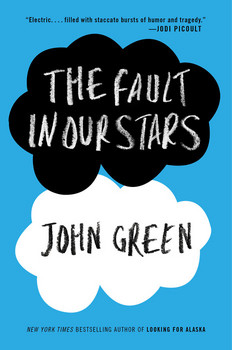
A Look Back on "The Fault In Our Stars"
It was surprising to me how important Hazel's favorite book within the novel, An Imperial Affliction, became to the plot of the story. Hazel states that she wants to lessen the impact of her death, so she only really associates with her parents, and she says that books are her best friends. She names that one book in particular as her favorite. The girl in Hazel's book, Anna, has cancer and is assumed to have died at the end of the novel. Hazel is really stricken by the ending- it ends mid-sentence, a very real ending, as Hazel notes. Either Anna died, or got too sick to go on writing. She wishes to God that she could ask the author what became of Anna's family members, but she has no idea how to contact him. While I liked the star-crossed lovers story line enough, this was the most heartbreaking part of the storyline to me (apart from learning about Hazel's sickness itself)- Hazel's wish to know what will become of her own family after her death. Hazel's question is always, "What happens to Anna's mother after she dies?" When she meets Peter van Houten, the author of An Imperial Affliction, and he will not answer her questions, Hazel becomes desperate. She shouts and cries at Peter, frantic to know what happens to Anna's mom after her death. It was so heartbreaking because clearly Hazel is really asking van Houten what happens to her mother after she dies. Hazel often mentions how much her mother worries for her, and she spends all of her time simply caring for Hazel. Hazel feels the desperate need to know what will become of her mother after she dies and leaves her behind. She wants assurance that her mother will be okay without her. To me, this was the most tragic and compelling part of the story, and I wish it had been touched upon more.
Sunday, December 23, 2012
"In the Cemetery..." just may be the most depressing thing I've ever read.
A short story by Amy Hempel, "In the Cemetery Where Al Jolson is Buried" makes tears spring to my eyes every time I read it. Just thinking about it is making me want to cry. Now, the first time I read it, I was absolutely confused. I thought it was about a lesbian couple. Then I thought it was about a mother who's baby died in the hospital as a newborn. I thought it was a bunch of different stories thrown together. It really did not add up to me.
After discussing it more clearly in class, I was having trouble holding back tears sitting at my desk. No, it was not about a lesbian couple, or a mother and her baby. It was about a young woman who felt responsibility for her dying friend whom she loved dearly, and she couldn't come to terms with the fact that her friend was dying. I've never had a friend die, and I can't imagine. I don't want to bring myself to imagine. Five years ago my grandmother died, and while I still feel pretty profound grief at losing her, for as long as I can remember I'd known she had cancer. It was, very unfortunately, a matter of when, not if. Just like in the story. And maybe that's where some of the tears regarding the story come from. But I don't think that's all of it.
Like I said, I've never lost a friend. One passage in the story was especially striking to me, and it feels so random that this out of the whole work would garner a reaction out of me. It is a description of a nurse giving the friend an injection, making both the main character and the sick friend tired. They sleep, and the main character dreams of her friend as a decorator, styling her house and singing, proudly taking the narrator to the door and showing off her accomplishment. Since at first I'd thought the story was a bunch of short stories about different people, I thought from this paragraph to the end was the description of a mother in the hospital with her sick newborn. She dreams of her daughter grown up- healthy, and wanting her mother's approval. The love of a mother for her child is so profound, and although in the story the main character is not a mother, she feels great responsibility for her friend. She feels guilty to leave her alone, and though she doesn't want to, she knows that her friend is nearing death and can't come to accept it.
Friday, December 7, 2012
Thursday, December 6, 2012
Spring Awakening and its musical counterpart: A Comparison
Spring Awakening (literally translated as The Awakening of Spring, or Spring's Awakening) by Frank Wedekind is a timeless classic tale about libido, rape, gays, teenage pregnancy, and suicide. Penned originally in 1891, the topics in the story were extremely controversial, and the play was banned in many places and otherwise censored. The play was not performed for the first time until over twenty years later in 1917, where the production was proclaimed pornographic and played only one performance on the New York stage. The musical version of the show, also named Spring Awakening, experienced a much different reception. It was near-universally acclaimed by critics and audiences alike and ran for over three years, being nominated for eight Tony Awards and winning three. While the names are the same, the two works are nearly as different from each other as how they were perceived by their audiences.
Broadly speaking, the play is considered by many to be much darker than the musical. Save for the fact that the play doesn't have pop/rock songs moving the story along, the original play somehow comes across more tragic than the musical in the way of the loss of innocence. The original play is indeed subtitled "A Tragedy of Childhood".
One of the bigger changes between the two shows is the occurrence between the main characters Melchior and Wendla in a hayloft. In the play version, Melchior kisses Wendla and rapes her as she tries to persuade him to stop. In the musical, Wendla still does not want to be intimate with Melchior, but eventually he gets her to agree. In both versions, Wendla has no idea what is going on.
The second big change between the two works is the final scene: Melchior in the graveyard, where he goes to mourn his friend Moritz's suicide and he comes upon Wendla's fresh grave. She died of a botched abortion. In the musical, the ghost of Moritz comes to sing to a weeping Melchior, who pulls out a razor and nearly kills himself until the ghost of Wendla joins them. Both ghosts sing to Melchior, telling him that they will always be with him and that he should go on with his life rather than kill himself. Melchior lowers the razor, and the musical ends in a song of hope and new life. The play has the same setup: Melchior happening upon Wendla's grave. In this version, the ghost of Moritz is entirely more sinister, actually urging Melchior to kill himself and join him in the afterlife. After a long time in thought to himself, Melchior nearly complies with the ghost, until a Masked Man comes from the shadows and convinces Melchior not to do himself in. The Masked Man makes Moritz explain his true intentions: he only wishes for Melchi to join him in the afterlife because he is lonely. Moritz admits that the afterlife is miserable. The Masked Man disappears, Melchi resolves to leave the graveyard, and the play ends.
Thursday, October 18, 2012
"Eveline"
"Eveline" by James Joyce is a story about a young woman torn between two worlds: the world she knows, and the world she longs to know. She lives to escape her near-abusive father and the monotony and routine of her everyday life. Or does she? Eveline is haunted by the thoughts of re-living the life that her mother lived, and yet, thoughts of her mother's life and death are what drives her back into her daily routines. The men in her life promise her two completely different things: Eveline's fiance Frank promises journey and a new, exotic life to Eveline. He assures the life that Eveline so desperately wants, and is ready and willing to provide it to her. The only thing that Eveline's father assures her is the exact life she's always been living. Just as Frank really is leading Eveline to a new life, a new beginning, she freezes. She stays motionless on the dock as Frank calls for her to board the ship with him. She will not move. Perhaps it is indecision, or perhaps it is just Eveline's fear of leaving behind what she knows. Will she be a disappointment to her mother's life if she leaves? Or if she stays? Her indecisive nature plagues Eveline for the majority of the story and clearly will effect the rest of the character's entire life. She does not wish to spend the remainder of her life where she is, but she is stuck.
Monday, October 15, 2012
No One's a Mystery, and it's the truth
The characters in "No One's A Mystery" by Elizabeth Tallent each tell a wildly different and interesting tale. The girl in the story, who remains nameless throughout, is eighteen and is convinced that she and her lover are going to get married and have kids and stay together for the rest of their lives. The man, Jack, is significantly older than the girl, married (to someone else), and knows that they won't stay together. Jack tells the girl that she will quickly move on from him once she realizes that she is too good for him, and she won't even remember his name in two years' time. The girl tells him that he is wrong- they will get married and be happy together. The differing views on the relationship could easily be an allusion to the relationship of any young couple.
I think the differing views on how the relationship may or may not turn out are definitely reflective on how a relationship would work for each of the characters. The girl is young. She is naive, and this dude is more likely than not her first serious boyfriend. No matter how morally wrong their entire relationship is, she loves him and she is convinced that she will spend the rest of her life with him.
Jack, on the other hand, tells a truer tale about their relationship. He sees that it will not be a fairy tale. He likely will not leave his wife for her. Even if he did leave his wife, I don't think he would marry the girl. At the end of the story, Jack acknowledges that their relationship is "bittersweet". He is with the girl because she is young and fresh and that would all change if he married her, just the way it changed when he married his first wife. He sees the more cynical side, but also the more realistic side.
The girl's and Jack's views on their future may also be a mirror to just how each one of them works. Jack is convinced that the girl will have moved on in two years, and even forgotten his name. Jack obviously has been able to easily move on from his wife (in a sense) and forget about her and her feelings enough to have had this girlfriend for two years, since she was sixteen. Jack is all that this girl has ever known, and she hope that he is all she'll ever know. That's a part of her innocence: she sees only the good in him and believes that they are soul mates because he's cheating on his wife with her. She thinks she will be the girl to change him. It just isn't so.
The girl is very happy and satisfied with her current situation. Jack, though possibly happy with his current situation, has a gloomy outlook on the future. He knows that he isn't willing to stay with his mistress. Though the relationship is wrong, morals aside the reader is inclined to root for the girl's side of the story early on. But reading farther and farther into the text can only assert that Jack is the wrong choice for the girl, and that she's going to need to move on, just as he says.
I think the differing views on how the relationship may or may not turn out are definitely reflective on how a relationship would work for each of the characters. The girl is young. She is naive, and this dude is more likely than not her first serious boyfriend. No matter how morally wrong their entire relationship is, she loves him and she is convinced that she will spend the rest of her life with him.
Jack, on the other hand, tells a truer tale about their relationship. He sees that it will not be a fairy tale. He likely will not leave his wife for her. Even if he did leave his wife, I don't think he would marry the girl. At the end of the story, Jack acknowledges that their relationship is "bittersweet". He is with the girl because she is young and fresh and that would all change if he married her, just the way it changed when he married his first wife. He sees the more cynical side, but also the more realistic side.
The girl's and Jack's views on their future may also be a mirror to just how each one of them works. Jack is convinced that the girl will have moved on in two years, and even forgotten his name. Jack obviously has been able to easily move on from his wife (in a sense) and forget about her and her feelings enough to have had this girlfriend for two years, since she was sixteen. Jack is all that this girl has ever known, and she hope that he is all she'll ever know. That's a part of her innocence: she sees only the good in him and believes that they are soul mates because he's cheating on his wife with her. She thinks she will be the girl to change him. It just isn't so.
The girl is very happy and satisfied with her current situation. Jack, though possibly happy with his current situation, has a gloomy outlook on the future. He knows that he isn't willing to stay with his mistress. Though the relationship is wrong, morals aside the reader is inclined to root for the girl's side of the story early on. But reading farther and farther into the text can only assert that Jack is the wrong choice for the girl, and that she's going to need to move on, just as he says.
Tuesday, October 9, 2012
Natalie Goodman from the drama Next to Normal viewed as a hero of literature.
Spoilers contained within.
1. Birth: Fabulous (odd) circumstances surrounding conception, birth, and childhood establish the hero’s pedigree, and often constitute their own monomyth style.
- Natalie was conceived as a result of her mother’s psychological need to have another child after her first child perished at a young age. Her mother refused to hold her after her birth in the hospital, which isn’t at all the norm with mothers and their newborns.
2. Call to Adventure: The hero is called to adventure by some external event or messenger. The Hero may accept the call willingly or reluctantly.
-Natalie’s call to adventure could be considered the opening scene of the play, where we see Gabe (her brother) and Natalie together for the first time, and how Gabe interacts with her. Gabe is revealed later to be no more than a figment of her mother's imagination, part of her delusions. Natalie is virtually ignored by her mother in favor of her sublime, non-existent son.
3. Helpers/Amulet: During the early stages of the journey, the hero will receive aid from a protective figure. The helper commonly gives the hero a protective amulet or weapon for the journey.
-In the second scene of the play, Natalie meets Henry, a teenage philosopher and romantic. Also a stoner. Henry and Natalie's personalities compliment each other perfectly: Natalie is uptight, Henry is mellow. Natalie is sarcastic, Henry is sweet. They grow to become boyfriend and girlfriend, and Henry takes on the role of Natalie's caretaker when her father becomes tangled up in her mother's problems. Henry is the only one to pay Natalie the attention she needs.
4. Crossing the threshold: Upon reaching the threshold of adventure, the hero must undergo some sort of ordeal in order to pass from the everyday world into the world of adventure.
-The first time Henry comes to the Goodman household to have dinner and meet her parents, disaster strikes. Natalie had been refusing to introduce Henry to her family up to this point, and we learn why in the form of Natalie's mother, Diana, emerging with a lit birthday cake announcing "It's someone's birthday!" Natalie freezes. The conversation goes as follows:
Henry: Whose birthday is it?
Natalie: (a pause) My brother's.
Henry: I didn't know you had a brother!
Natalie: I don't. He died before I was born.
Natalie storms out of the room after her father has to explain to her mother, again, that her brother is no longer alive. This scene is proven to be Natalie's breaking point. She feels that she will never be able to live up to the standards set by her mother's imaginary son, and thus turns to tearing herself down. Natalie begins experimenting with drugs (stolen from her mother) and alcohol.
5. Tests: The hero travels through the dream-like world of adventure where he must undergo a series of tests. These trials are often violent encounters with monsters, sorcerers, warriors, or forces of nature.
-Natalie's tests are without a doubt her traipses into the world of clubs and drugs. Though once consumed by school and getting into college, she begins to act recklessly, taking drugs before her audition for Yale and blowing it. Big time. She goes to clubs every night for a week straight while her father is at the hospital with her mother, who has undergone ECT treatments in an attempt to rid her of her delusions. She has, as the phrase goes, gone "off the deep end."
6. Helpers: The hero is often accompanied on the journey by a helper who assists in the series of tests and generally serves as a loyal companion.
-Throughout all of her major breakdowns, Henry is there for Natalie. Her breakdown at her big recital was due to the fact that her dad had promised that both he and her mother would be there to watch her, but failed to show up. Overlooked once again, Natalie breaks under pressure and starts banging on the piano. Henry was backstage with her and was the one to usher her away and bring her home. And the week Natalie spent clubbing, Henry was there with her, chaperoning her in a way, and making sure that she didn't do something she would regret. One night, Natalie runs off without Henry and he searches for her until he finds her passed out on the street. He then brings her home and stays with her until he's sure that she will be okay. Without Henry, Natalie would not have made it through her trials. He is a helper if there ever was one.
7. Climax/The Final Battle: The critical moment in a hero’s journey in which there is often a final battle with a monster, wizard, or warrior which facilitates the particular resolution of the adventure.
-Although hardly a monster, Diana is basically the entirety of the reason for Natalie’s inner conflicts. All of her troubles in life, in one way to another, lead back to her mother. There is a scene towards the end of the play in which Diana apologizes to Natalie for being an absent mother for nearly her entire life. At first Natalie doesn't accept the apology, saying, "I don't believe you." Diana goes on to tell her, for the first time, how her brother passed away as a baby. It was the first time Natalie had ever heard the way of her brother's passing. With her mother finally, finally accepting her son's passing, Natalie is able to begin to come to terms with things and forgives her.
8. Flight: After accomplishing the mission, the hero must return to the threshold of adventure and return to the everyday world.
-For most of Act II, when he's not saving her from clubs, Henry tells Natalie that he misses the old her. He repeatedly tries to get her to agree to attend their school's spring formal with him. Though denying him for most of the act, after somewhat working out with her relationship with her mother Natalie immediately afterward shows up at the dance where Henry had been waiting to see if she'd come for him or not. It could be said that Natalie's "mission" is just to gain the approval from her mother that she has so desired her entire life. Underneath her endless schoolwork and intense sonata-ing at the piano, all she really wants is her mother to notice her for who she is. Once that is accomplished, Natalie is once again free to be who she wants to be and can return to her life with Henry. The scene at the dance, and the remainder of the scenes in the rest of the show, do confirm that Natalie's life returns somewhat to a sense of normality (as normal as her life has ever been). Her monsters have been overcome, her mission is complete.
9. Return: The hero again crosses the threshold of adventure and returns to the everyday world. The return usually takes form of an awakening, rebirth, or resurrection.
-Natalie returns home after the dance to find her father sitting alone in the dark, weeping. Though at first stunned by the sight, she quickly realizes that her mother has left them and assures her father that everything will be okay for them. "We'll live, you'll see," she says as she pulls the cord on the lamp and the room is flooded with light.
10. Elixer: The knowledge that the hero acquired during the adventure is now put to use in the everyday world. Often it has a restorative or healing function, but it also serves to define the hero’s role in society.
-In the final scene of the show, Natalie is shown talking to Henry over her kitchen table. She tells him that Diana is staying with her parents ("Going home has never solved any of my problems,") and that they still keep in touch over the phone. The relationship between Henry and Natalie has been restored to where it was in the beginning of the show: they joke around and are generally adorable together. Natalie has returned to her former self before her trials, but even still, in a way she is different. Her tough few months helped her grow and mature in only good ways. Her outtake from her issues is clear. It's also clear that she will move on: she sees her mother leaving as something that was inevitable, and it doesn't bother her. She accepts that her mother needed to leave and actually even sees it as a good thing, moving forward. She has grown up and beyond, and is wise beyond her years. Almost as wise as Henry!
11. Home: The hero comes back from this mysterious adventure with the power to bestow boons on his fellow man.
-Henry and Natalie sit down at her kitchen table to do homework together, and both are surprised when her father carries a birthday cake out of the kitchen. This time, the reaction is a happy one. It's Natalie's seventeenth birthday. She has gotten through what will probably be looked back on as the roughest time in her life, and she has only flourished.
Sunday, October 7, 2012
Tuesday, October 2, 2012
The Phantom of the Soap Opera
The musical is based on Andrew Lloyd Webber's musical The Phantom of the Opera. The Phantom of the Opera is, in turn, based on the original novel Le Fantôme de l'Opéra by French novelist Gaston Leroux. The number one reason why I do not agree with LND's existence would have to be the fact that Lloyd Webber himself did not pen the original source material. The only person who could respectfully write a true sequel to The Phantom of the Opera would be Leroux himself. It could be viewed as Lloyd Webber writing a sequel to his musical and not the actual story, but considering how close the first musical really is to the original story I don't assume it.
The second reason I dislike Love Never Dies so much HAS to be the fact that it, though technically a sequel to the original POTO, it really isn't a sequel at all. The storyline is just bizarre and the characters are absolutely NOTHING like their ten years previous counterparts from Phantom of the Opera. We will ruminate below:
In the first installment, Christine is raised by ballet master Madame Giry in the Paris Opera house and is basically a sister to Mme Giry's daughter Meg. After Christine falls in love with her childhood friend Raoul, the Phantom goes just a little crazy, stalking Christine, killing a few people and ultimately setting the opera house in flames. Christine is kidnapped by the Phantom and taken to his lair, where he then traps her fiance Raoul. She is given an ultimatum: marry Phantom and live with him for the rest of their lives, or watch Raoul die and go free. Christine takes pity on the Phantom and kisses him. He is so moved by the first show of compassion towards him in his entire life that he lets both go free to be together.
The storyline of LND goes as so: After being freed by the mad man who was holding her in his creepy lair entirely against her will and nearly killing her fiance who she loves, Christine returns to the Phantom on the night before her wedding to sleep with him. The next morning, the Phantom, who has been obsessed with Christine since she was a young girl and had weeks before kidnapped her, LEAVES Christine for no discernible reason. She goes on to marry Raoul, who by the events of LND has lost all of his money and is a drunk. The Giry's hate Christine now for leaving the Phantom. Basically Meg kidnaps Gustave for the Phantom's attention, shoots Christine by accident (somehow), and Christine dies in the arms of the Phantom (but not before she can tell Gustave that his real father is the Phantom and not Raoul).
Just no. Christine even sings to Phantom about how much she loved him. Unless Christine is suffering from a serious case of Stockholm Syndrome, I don't see how that could have been the case. Phantom is basically portrayed as being more sane than Raoul in this installment. In fact, every single character present in LND who was in the original is a near opposite to what they were in the original. Love Never Dies also takes place on Coney Island, where Christine is called to perform. When, exactly, did all of these natives to France learn to speak English? And am I really expected to believe that the Phantom would react the way he did to Christine being shot and killed when she was finally agreeing and happy to be with him? He was killing dudes left and right when she got engaged.
In all seriousness, Love Never Dies is technically just a fanfiction by Lloyd Webber that cost a whole lot to produce. One thing going for it: the score of the show is gorgeous. But I'm not buying that storyline. Legend has it that when he was first writing the show, Lloyd Webber's cat jumped onto his computer and erased the entirety of the work he had written so far. This is the man who composed the musical Cats. If that isn't a sign from above to cease and desist, I don't know what is.
Subscribe to:
Posts (Atom)