Another of William Wordsworth's well-known poems is “It
is a Beauteous Evening, Calm and Free”. Admittedly, I only ended up reading it because I felt that my paper would need another poem to be talked about. But I'm glad I ended up reading it. Not only did it help wrap my paper together beautifully, I think it's one of my new favorites by Wordsworth. The poem is believed to be about his young daughter Caroline after he meets her for the first time after ten years. It is a fourteen line sonnet with an ABBAACCA rhyme scheme.
The most striking thing about the poem is the technique with which it is written. The first six lines are written smoothly, with soft words sprinkled throughout. It is rather pleasant and easy to read. After the sixth line, however, the words Wordsworth uses become much harsher. The poem itself becomes choppier almost instantly by the usage of exclamations and sentences ending more quickly. The unexpected turn of the poem is not unlike an abrupt churning up of a storm at sea.
Friday, March 15, 2013

Wednesday, March 13, 2013
"I Wandered Lonely as a Cloud"

"I Wandered Lonely as a Cloud" is the first poem I ever read by William Wordsworth. I loved him immediately. I went on to write every essay I could about him and this poem. I was so taken by his use of nature imagery and the sweet title of the poem. Even just the main basis of the poem- you don't have to be lonely if you're alone- drew me towards Wordsworth.
"I Wandered..." is a lyric poem consisting of four stanzas in iambic tetrameter. Wordsworth wrote the poem for his beloved sister, whom he first discovered the daffodils that inspired the poem with. The poem contains much alliteration. It also personifies clouds by comparing them to a lonely human, as well as personifying daffodils by saying they are dancing.
It's undeniable that the most striking thing about Wordsworth's poem is the nature imagery. Not a stanza goes without it. Barely a line in the poem does not allude to nature in one way or another. Although the poem's title itself could sound rather like the poem was melancholy or sad, the words Wordsworth uses within makes it the complete opposite. The word "dance" is used throughout, brightening the poem. Other words generally associated with happiness- "glee", "bliss", "gay", and "jocund" are a few examples pulled from the final two stanzas.
Monday, February 25, 2013
its a shame
its a shame that in 6 or so billion years, any and all existence on earth will be wiped out by the sun’s expansion, and it’s almost scary to think about how even now the sun continues to grow bigger and hotter, sexy and hotter let’s shut it down. pound the alarm
Monday, January 7, 2013
"There's a grief that can't be spoken": Beginning Les Misérables

For months I've been searching for a hard copy of Victor Hugo's grand work Les Misérables to buy and own- granted, I've only gone to secondhand bookstores this far, and I didn't think to ask for Christmas. Either way, I've been trying to find it since last spring. I found out from a friend it was free on Kindle, but it wasn't until I found out I could use my mom's Kindle account on my phone that I actually (finally) got my eyes on a copy of the 959-page-long novel. Already being a huge fan of the musical based on the novel, I was ready to rise up to the occasion for my love of the story and the characters and complete what will be the longest novel I've ever dared to read.
Thus far, I'm fifty pages into my experience. It is split into five books, and begins with Book I: Fantine. Fifty pages into Book I, I haven't met Fantine yet. I haven't even met main character Jean Valjean yet. So far, the only character I know is the Bishop, who by knowing the musical I know sets Jean Valjean onto his path to salvation. And though I usually get discouraged by things like this (fifty pages so far on a character who has little to do with the story comparatively), I find myself enthusiastically reading rather than skimming by long-looking paragraphs or needing to go back and re-read sections because my mind wanders. I'm excited to finally reach Jean Valjean's and Fantine's story and truly begin the novel, but I'm not learning about the Bishop grudgingly, either. Maybe it's because I'm reading it on my own accord, or maybe it's because I already have a love and knowing of the story and characters, but I'm excited to read "the brick", as it is called, and know what I've been missing out on.
I still hope to be able to find an unabridged hard copy of the novel somewhere, which is closer to 1,500 pages long than 959, but until then I'll do with having the lighter and more portable phone version.
Saturday, January 5, 2013
A Look Back on "The Fault In Our Stars"
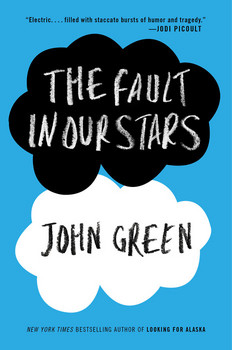
It was surprising to me how important Hazel's favorite book within the novel, An Imperial Affliction, became to the plot of the story. Hazel states that she wants to lessen the impact of her death, so she only really associates with her parents, and she says that books are her best friends. She names that one book in particular as her favorite. The girl in Hazel's book, Anna, has cancer and is assumed to have died at the end of the novel. Hazel is really stricken by the ending- it ends mid-sentence, a very real ending, as Hazel notes. Either Anna died, or got too sick to go on writing. She wishes to God that she could ask the author what became of Anna's family members, but she has no idea how to contact him. While I liked the star-crossed lovers story line enough, this was the most heartbreaking part of the storyline to me (apart from learning about Hazel's sickness itself)- Hazel's wish to know what will become of her own family after her death. Hazel's question is always, "What happens to Anna's mother after she dies?" When she meets Peter van Houten, the author of An Imperial Affliction, and he will not answer her questions, Hazel becomes desperate. She shouts and cries at Peter, frantic to know what happens to Anna's mom after her death. It was so heartbreaking because clearly Hazel is really asking van Houten what happens to her mother after she dies. Hazel often mentions how much her mother worries for her, and she spends all of her time simply caring for Hazel. Hazel feels the desperate need to know what will become of her mother after she dies and leaves her behind. She wants assurance that her mother will be okay without her. To me, this was the most tragic and compelling part of the story, and I wish it had been touched upon more.
Sunday, December 23, 2012
"In the Cemetery..." just may be the most depressing thing I've ever read.

A short story by Amy Hempel, "In the Cemetery Where Al Jolson is Buried" makes tears spring to my eyes every time I read it. Just thinking about it is making me want to cry. Now, the first time I read it, I was absolutely confused. I thought it was about a lesbian couple. Then I thought it was about a mother who's baby died in the hospital as a newborn. I thought it was a bunch of different stories thrown together. It really did not add up to me.
After discussing it more clearly in class, I was having trouble holding back tears sitting at my desk. No, it was not about a lesbian couple, or a mother and her baby. It was about a young woman who felt responsibility for her dying friend whom she loved dearly, and she couldn't come to terms with the fact that her friend was dying. I've never had a friend die, and I can't imagine. I don't want to bring myself to imagine. Five years ago my grandmother died, and while I still feel pretty profound grief at losing her, for as long as I can remember I'd known she had cancer. It was, very unfortunately, a matter of when, not if. Just like in the story. And maybe that's where some of the tears regarding the story come from. But I don't think that's all of it.
Like I said, I've never lost a friend. One passage in the story was especially striking to me, and it feels so random that this out of the whole work would garner a reaction out of me. It is a description of a nurse giving the friend an injection, making both the main character and the sick friend tired. They sleep, and the main character dreams of her friend as a decorator, styling her house and singing, proudly taking the narrator to the door and showing off her accomplishment. Since at first I'd thought the story was a bunch of short stories about different people, I thought from this paragraph to the end was the description of a mother in the hospital with her sick newborn. She dreams of her daughter grown up- healthy, and wanting her mother's approval. The love of a mother for her child is so profound, and although in the story the main character is not a mother, she feels great responsibility for her friend. She feels guilty to leave her alone, and though she doesn't want to, she knows that her friend is nearing death and can't come to accept it.
Friday, December 7, 2012

Subscribe to:
Posts (Atom)